Your Team Asks AI Instead of Each Other
A survey of more than a thousand US desk workers linked going to AI instead of a colleague with lower team trust and coordination, a pattern that dashboards counting AI usage are not built to show.

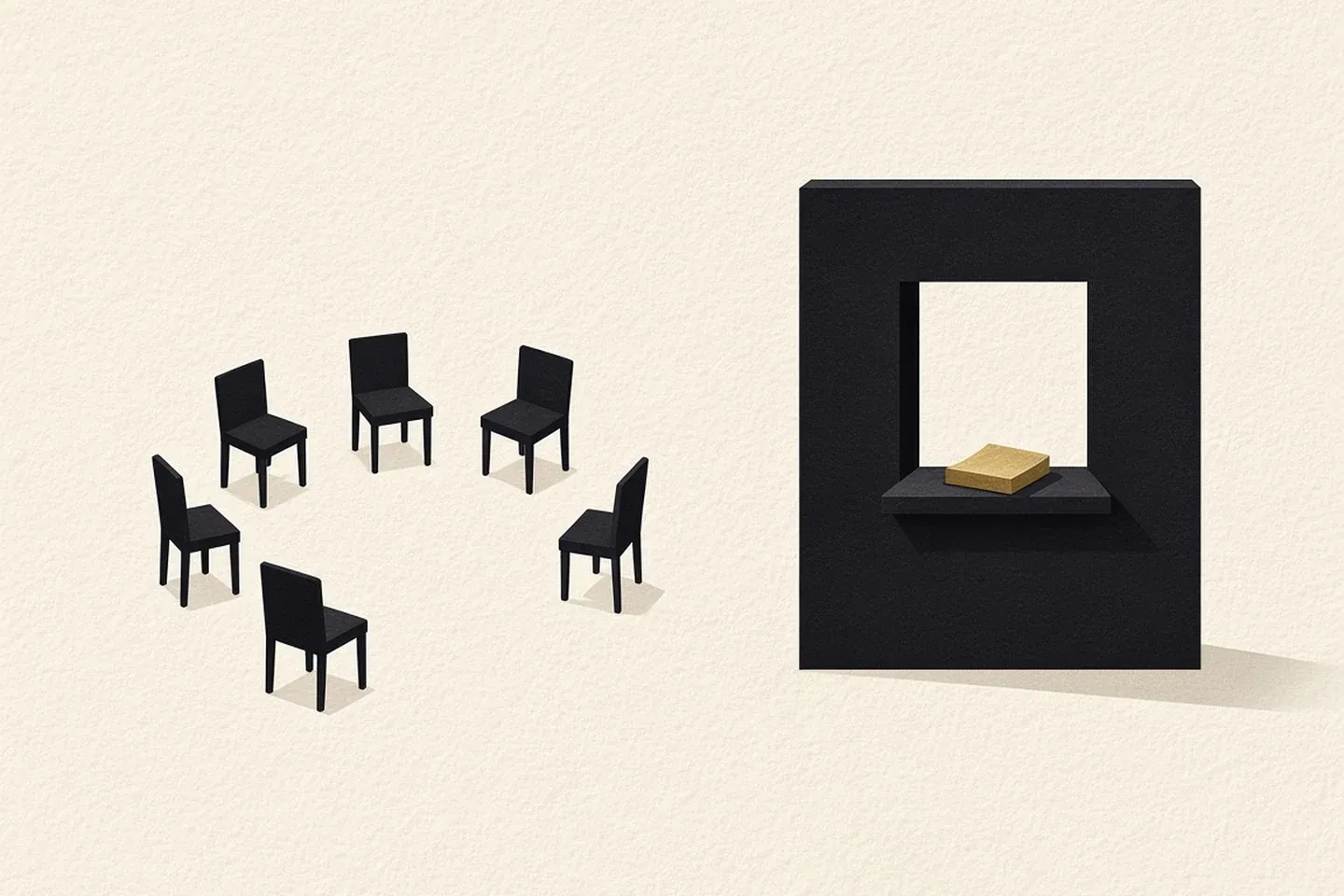
The quick question to a colleague was never only a request for information, and a team that stops asking may stay productive for a long time before it notices what it has lost.
Most offices I have known had a particular kind of interruption, in which someone leans back from their screen and asks the room whether anybody knows how finance treats a credit note, or who last touched the pricing model, and within a minute two people have answered, one of them wrongly, and a third has wandered over to settle it. Nobody would list that exchange as work, yet by the end of it everyone within earshot knows a little more about who knows what. The same question now often goes into a chat window, comes back in a few seconds as a tidy paragraph, and nobody else in the room hears it asked.
The usual way to judge that change is by the speed and quality of the answer, on which it often looks like an improvement. The STAR Framework would ask a second question, because it treats what people can get done and whether they feel connected to the people they do it with as separate things, and a quick answer from a model can serve the first while doing nothing for the second. New research reported in Harvard Business Review is useful because it put survey numbers on what happens to trust and coordination when people go to AI instead of each other. Reading it as a story about relatedness, and about what STAR calls Silent Fragmentation, is my interpretation and not something the researchers tested.
The map of who knows what
On 15 October, Kate Niederhoffer, Kristina Rapuano, Alex Liebscher, Alexi Robichaux and Jeffrey T. Hancock published Team Dynamics Weaken When Employees Turn to AI Instead of Colleagues in Harvard Business Review. Their starting point is transactive memory, the idea developed by the social psychologist Daniel Wegner (Wegner, 1987) that a group builds a shared understanding of who is responsible for knowing what, so that each person can rely on the others’ expertise without holding all of it themselves. According to BetterUp, where four of the five authors work, the team surveyed 1,033 full-time desk workers on project teams across more than 20 industries, and HBR’s newsletter summary describes them as US workers.
The findings pull in two directions at once, because people who reported more AI use rated their teammates’ knowledge as more specialised, yet the more they reported turning to AI instead of a teammate, the lower they rated their team’s trust and coordination. On teams where going to AI instead of a colleague was the norm, BetterUp reports coordination 22.3% lower and trust 21.9% lower, while 49% of workers said their teammates replace them with AI at least some of the time, and those who felt replaced were less likely to feel they mattered at work and more likely to be looking for a new job. The authors call the pattern “relationslipping”, which HBR’s summary describes as the weakening of a team’s working relationships as its members substitute AI for each other. They identify two routes to it: people who skip a conversation in favour of a quick answer stop updating their map of who knows what, and colleagues who offload work to AI make their own thinking harder to see, so the map loses accuracy for everyone else. A BetterUp Labs post from September, describing a 1,000-person study run with the Stanford Social Media Lab, adds that 83% of workers said AI takes the place of a teammate when they need quick information, which is close to the interruption I started with.
What the survey cannot carry
This is a survey rather than an experiment, so the figures describe associations in what people reported about themselves and their teams, not proof that AI use caused the decline. The arrow could run the other way, since a team with thin trust might send its questions to a model for that very reason, and the authors’ finding that people with low psychological safety were more than twice as likely to go to AI instead of a teammate is at least consistent with that reading. Four of the five authors work at BetterUp, a coaching company, which is worth knowing without being a reason to dismiss the work, and the research did not test STAR either, so everything that follows about needs, lenses and DCTA is my interpretation.
The need nobody is measuring
STAR draws on Self-Determination Theory, in which Richard Ryan and Edward Deci describe three basic psychological needs, autonomy, competence and relatedness (Ryan & Deci, 2000). A copilot can serve competence very well, and often autonomy too, since nobody has to wait for a colleague to be free, but my reading, which the survey did not test, is that the quick question to a colleague was never only a request for information; it was also a small act of relatedness, in which one person showed that they valued another’s knowledge and the other got to be useful. On that reading, swapping it for a model keeps the information and drops the relatedness, and since nothing in the transaction fails, the loss is easy to miss. That would sit comfortably with the finding about people who felt replaced, although the survey measured whether they felt they mattered, not relatedness as Self-Determination Theory defines it.
STAR’s Socialiser lens, which foregrounds connection, inclusion and relationships, is the obvious place to look, with nobody on the team assigned to it. It asks whether the people doing the work are still in touch with one another, which is the question adoption dashboards, built to show who uses AI and how often, are least able to answer. The need it watches can go hungry in plain sight, because from the outside a team that has stopped asking each other things can look much like one that has become very efficient.
Social Identity Theory, another of STAR’s pillars, offers a second interpretation, starting from Henri Tajfel and John Turner’s argument that part of how people see themselves comes from the groups they belong to (Tajfel & Turner, 1979), and a team is one of those groups only while its members experience it as one. The authors’ line, as quoted by Forbes, that “everyone is acting sensibly on their own and the group is worse off for it” reads to me as a description of a group becoming a set of individuals who happen to share a channel. Each private exchange with a model is reasonable on its own terms, while the sum of them may leave less of a shared “us” to belong to, though the survey measured trust and coordination, not identity.
Why the dashboard stays green
The same Forbes piece quotes the authors’ observation that success “has been incentivized and measured by how many individuals are using AI well, not whether the team is working well together.” STAR’s Distortion Layer, its name for the cognitive bias pillar, is where I would look for the reason that goes unchallenged. Leaders tend to judge by what is counted, and usage is easy to count while the conversation that did not happen leaves no record at all, so an organisation can watch adoption climb and read it as unqualified good news. No part of the research examined how managers read their dashboards, so this is interpretation, and an awkward one for anyone who has presented a slide of rising usage figures with a straight face.
STAR’s DCTA framework names four complementary contributions to collective work, and a team can ask whether its work has enough of each without guessing anyone’s mode. Aligner is the contribution of connection, shared understanding and cohesion, and STAR’s practitioner reference uses the name Silent Fragmentation, as an illustration rather than a demonstrated consequence, for the pattern in which work runs short of it, describing individuals working alone without cohesion. The AI version is awkward because it needs nobody to leave and no relationship to break; the questions that used to carry a little Aligner contribution are simply routed elsewhere while the team keeps delivering. Silent Fragmentation tends to look like efficiency until the day somebody needs to know who knows what. In STAR’s own terms a perceived gap like this is a hypothesis about how the work is organised, not a diagnosis of any person, and the survey tested neither the lens nor the framework.
A toolkit for the conversations that went missing
- Track who asks whom, as well as who uses what. Alongside adoption figures, ask in a retrospective where people went for help in the past fortnight, and treat a team that has stopped naming colleagues as information in its own right.
- Keep contact frequent, even when it is asynchronous. BetterUp reports that among daily AI users, frequent contact with their team was linked to 28% higher coordination and 19% higher trust, which is an association rather than a guarantee but costs almost nothing to act on.
- Use AI to prepare the question, then take it to the person. The authors recommend using AI to prepare for conversations instead of replacing them, so that the model sharpens the question and the colleague still gets asked.
- Reward the team result as well as individual fluency. If incentives count only how well each person uses AI, people will sensibly optimise for that, so measure the team too.
The test question fits on a sticky note: when did you last take a question to a colleague instead of a model?
Back in that office, the model’s answer about the credit note would probably have been better than the one shouted across the room, and it would be daft to pretend otherwise. What it cannot do is tell everyone within earshot who knew, who was wrong and who cared enough to walk over and settle it, and a team that stops learning those things can stay very productive for quite a long time before anyone notices that it has quietly stopped being a team.
If you would like to see which Mindsets tend to lead for you, the STAR Cognitive Profile Assessment at starassess.com takes 33 questions, and the assessment and its full report are both free, which may be a useful starting point for noticing how much of your own working week depends on the people around you.
David Chadderton is a behavioural strategist, Chief Marketing Officer and STAR Dynamics. He writes The Unoptimised Human.
References
BetterUp. (2026, 15 October). LinkedIn post announcing the HBR research.
McKendrick, J. (2026, 5 November). ‘Relationslipping’: AI threatens the fabric of teamwork, studies show. Forbes (syndicated by Yahoo Finance).
Niederhoffer, K., Rapuano, K., Liebscher, A., Robichaux, A., & Hancock, J. T. (2026, 15 October). Team dynamics weaken when employees turn to AI instead of colleagues. Harvard Business Review. Product summary, H09BZ1.
Rapuano, K., & Liebscher, A. (2026, 14 September). The cost of AI displacement: Why AI adoption is a team sport. BetterUp.
Ryan, R. M., & Deci, E. L. (2000). Self-determination theory and the facilitation of intrinsic motivation, social development, and well-being. American Psychologist, 55(1), 68–78.
Tajfel, H., & Turner, J. C. (1979). An integrative theory of intergroup conflict. In W. G. Austin & S. Worchel (Eds.), The Social Psychology of Intergroup Relations (pp. 33–47). Brooks/Cole.
Wegner, D. M. (1987). Transactive memory: A contemporary analysis of the group mind. In B. Mullen & G. R. Goethals (Eds.), Theories of Group Behavior (pp. 185–208). Springer.
Eight minutes. Thirty-three questions.
A precise picture of how you operate: motivations, decision style, and blind spots. Free to start.
- S
- T
- A
- R
The canonical source.
Essays, when there is something worth sending. Choose the subjects you want. I will ask you to confirm the address before I write.